Yes, as usual, I am late to the party that is Olive. But, as they say, better late than never!
When mom decided to come to Delhi, I was all in a tizzy planning fun things to do with her over the weekend, on the days I could manage to take off from work, and in the evenings after office. One place that was at the top of my list was Olive.
So on a Friday afternoon, dressed to the nines, we hit the road and made our way there. And boy, were we in for a treat!
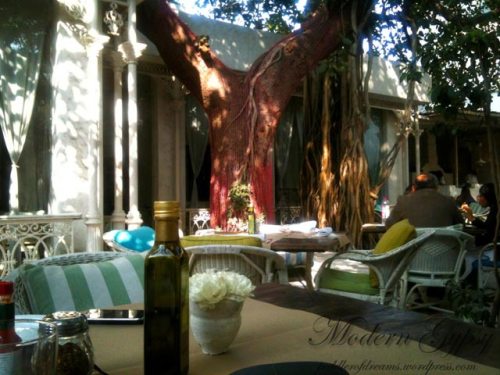
Olive is an Italian restaurant, part open part indoors. We chose to sit outside, under the shade of an ancient banyan tree on a cool winter afternoon. The seating is spread apart, so you have a bit of privacy at your table and room to let your eyes wander. From the huge banyan tree to the open kitchen to catching glimpses of the interior of the restaurant, from where a blue shelf was winking out at us.
British versions of the Harry Potter series (Photo credit: Wikipedia)
I’ve developed a love for fantasy fiction. It started with JK Rowling’s Harry Potter series, which I read through college and into adulthood. After a long break from this genre, I returned to it with Stephenie Meyer’s Twilightseries, which was recommended to me by a colleague in the US. (I don’t understand the hysteria around these novels – after reading the first book I wanted to gag, but they did seem to get better. Or maybe I knew what to expect.) Then came Philip Pullman’s His Dark Materials trilogy (Golden Compass, The Subtle Knife, The Amber Spyglass), the brilliant and complex Fire & Ice series by George RR Martin and Joanne Harris’ novels based on Norse mythology (Runemarks and Ruinlight), and I was firmly hooked onto the genre.
So when I got the opportunity to review Bartimaeus for RHI, I jumped at the chance.
The novel starts with one of King Solomon’s 17 magicians commanding the demon Bartimaeus to search “the known world for objects of beauty and power” at the behest of the king. But keeping charge of a demon is no easy task. You have to be sure that your commands are worded without any loopholes that can be exploited and that you are always within your pentacle, or the demon will be quick to kill you to gain its freedom.
“Rizim had put the other eye out on a rare occasion when our master had made a slight mistake with the words of his summoning. We’d additionally managed to scorch his backside once or twice, and there was a scar on his neck where I’d come close with a lucky ricochet, but despite a long career commanding more than a dozen formidable djinn, the magician remained vigorous and spry. He was a tough old bird.”
A feat that Bartimaeus accomplishes within the first few chapters of the novel. And that earns him the retribution of Solomon, who orders the magician Khaba to summon and enslave him. At the same time, he tasks Khaba with constructing a marvellous temple with a workforce comprising of a bunch of demons, including Bartimaeus. But true to form, Bartimaeus manages to irk King Solomon yet again, getting Khaba kicked off the temple project and sent to the desert to hunt bandits.
Meanwhile, in far away Sheba, the Queen receives a messenger from the King. Seeing as she has refused his offer of marriage multiple times, Solomon now orders her to pay him a tribute of frankenseince or see her city destroyed at the hands of an army of spirits. What makes Solomon’s threat so ominous is the ring that he discovered years ago, which allows him to summon an untold number of spirits and command the forbiddingly powerful Spirit of the Ring. The threat of this ring brings a number of magicians to Solomon’s court, whose summoned demons are used to build temples, maintain law and order and keep the peace. It’s a ring that everyone wants…but no one should have. Anyway, back to Sheba. To save her country, the queen sends Asmira, a loyal captain of her guard, to Jerusalem to kill the king and take his ring. And this is where the real fun of the novel begins.
Jonathan Stroud’s version of Jerusalem is peopled with monstrous djinnis, marids and afrits, all of whom are enslaved to a magician and must carry out their every command. He’s taken stories about King Solomon from the Old Testament and given them a magical spin, with Bartimaeus cooking up trouble, cracking humorous wisecracks and causing mayhem wherever he goes. The story has some interesting twists and turns, with evil getting its due reward (or rather, punishment) in the end.
The principal character of the novel is Bartimaeus, and he is absolutely delightful! He’s got this wicked sense of humour
“Then again, Solomon was human. And that meant he was flawed (Go on, take a look at yourself in the mirror. A good long look, if you can bear it. See? Flawed’s putting it mildly, isn’t it?)”
with a side of sarcasm
“It’s the same with spirit guises; show me a sweet little choirboy or a smiling mother and I’ll show you the hideous fanged strigoi it really is. (Not always. Just sometimes. *Your* mother is absolutely fine, for instance. Probably.)”
Jonathan has also taken care with his human characters. Asmira, for instance, goes from being convinced about her mission to kill Solomon, to feeling helpless and worthless, and finally finding her sense of purpose as the story unfolds. King Solomon too, despite being a known figure, has been given some rather interesting character twists.
Most of the chapters are narrated by Bartimaeus, and these include back stories and explanations of various magical (and other) terms – told in the form of footnotes – in his distinctive (read: witty and sarcastic) voice. Some of the chapters are narrated by Asmira and others are in third person – and all of these transitions are handled well.
What I enjoyed most about the book, though, was Bartimaeus and his wit! The Ring of Solomon is the prequel to the Bartimaeus trilogy, which I haven’t read. So, I can say with full confidence: if you haven’t read the trilogy and don’t think you want to get into one, read this one book – it works perfectly as a stand-alone novel. Me? I’m going to be reading the rest of the trilogy – I need to know what trouble Bartimaeus cooked up in modern day London! 😉
Disclaimer: I got a copy of this book from Random House India, but the review and opinions expressed are my own.
It’s Sunday afternoon. Armed with a cup of coffee, a pen and small notepad, and my iPad, I make my way to the sofa. It’s my favorite spot in the drawing room – perfectly positioned to allow me to soak up the sun in winters and directly in the path of a cross-breeze when I open the doors of the balconies in summers.
Image via CrunchBase
As I flop down on the couch, I fire up the Twitter app on my iPad and search for #TSBC. It is 3:00 pm. For the next one hour, I will be busy tweeting – replying to questions and people; retweeting and favourite-ing tweets that I like; laughing out loud at times; at others, making furious notes in a small notebook. At the end of that hour of Twitter interaction, I will come away with new thoughts and perspectives, as well as a list of interesting books or authors I knew nothing about.
Isn’t this book cover a beauty? Shared on the #TSBC chat on book covers by Random House India
See, #TSBC is the Sunday Book Club, a weekly chat that takes place on Twitter every Sunday at 3:00 pm IST where we talk all things, well, books. Topics have ranged from discussing movie adaptations of books, autobiographies, the works of Oscar Wilde, book covers, the Ramayana, banned books, and a fun discussion on what book…And, at the end of every chat, one lucky person stands to win a book*! I won First Day First Show by Anupama Chopra during one of the initial few chats on books and films. The question was “If your memoir were to be made into a film, what would you name it and who would you cast in it?” And my rather flippant answer was “The girl who tried to climb a mountain and walked down a hill. Starring Julia Roberts as me. :-P” Pretty cool, huh?
Started by three friends and book lovers Raghav, Neo and Sudha, the club is 11 weeks old. And participation (both from India and abroad) has grown by leaps and bounds. This really doesn’t come as a surprise because they have some well-thought-out questions on each topic, leading to healthy discussions among book lovers.
If you love books, this is one chat you wouldn’t want to miss! There are, however, a few Do’s and Don’ts.
No self promotion during the chat
No rudeness and flaming – please respect everyone’s point of view
Do mention which question you are answering (A1, A2 etc)
Do tag your tweets with #TSBC or they won’t reach all the Tweeps who are participating
Midnight’s Children tells the story of “Saleem Sinai, later variously called Snotnose, Stainface, Baldy, Buddha and even Piece-of-the-Moon,” who was born on 15 August 1947 at the stroke of midnight – at the same hour that India won her independence. It is a story that first chronicles 32 years of his grandparents’ and parents’ lives, before focusing on Saleem’s life in Bombay, Pakistan and Bengal. It is also a novel about India; tracing her journey from the heights of independence (infancy) to her ordinary adulthood, culminating with Indira Gandhi’s Emergency rule.
But this bland description doesn’t do justice to Rushdie’s sweeping novel. It says nothing about his magical prose, about the explosion of colors and smells and sights and sounds. So let me tell you a little more about Snotnose.
Born at midnight, at the precise moment of India’s independence, Saleem was “mysteriously handcuffed to history…thanks to the occult tyrannies of those blandly saluting clocks.” His birth was celebrated with fireworks. His picture was printed in the newspaper. Prime Minister Jawaharlal Nehru sent him a letter saying “We shall be watching over your life with the closest attention; it will be, in a sense, the mirror of our own.” He grew up with a sense of his own importance. He grew up wondering about his purpose. And in his quest for a quiet place in which to think, he found himself retreating to his mother’s laundry hamper. Where one day he discovered his gift for telepathy. From the age of nine, he could enter into other lives at will. And finally, he found all the other magically gifted midnight children scattered across India. At the age of 10 he set up a Midnight’s Children Conference, where he hoped the children could come together to discuss the fate of the nation. But like all 10-year olds, they were overtaken by petty squabbles and dissonance.
As you read Saleem’s story, the “chutnification of history” and “the pickling of time”, you can see parallels with India. Allegorical though they may be, some of them are only hinted at, but they are there. The signs of the potential that India could achieve at birth, the quest for purpose, the slow, inevitable decline to mediocrity. Of course, a lot of events take place because of Saleem. After all, the reason for the Indo-Pakistan war was the annihilation of the Sinnai family!
What more can I say about Stainface? He’s pompous, arrogant, self-centered, grandiose, and somehow loveable. As the narrator of this audacious novel he is absolutely brilliant. He jumps around from one time period to another. When he makes his tall claims, his companion Padma tries to ground him to reality, but of course, he refuses to be so grounded.
In this sweeping canvas of a story, Rushdie brings in the details of a miniaturist. The places and times are captured down to the last detail. Like the Pioneer Café, where Saleem’s mother meets her first husband Nadir Khan.
“…with filmi playback music blaring out from the cheap radio by the cash till, a long narrow greeny room lit by flickering neon, a forbidding world in which broken-toothed men sat at reccine-covered tables with crumpled cards and expressionless eyes.”
The characters, even the minor bit players, are finely detailed. No player, or event, has been tacked on as an afterthought just because an “India novel” would be incomplete without it. There is a lot of history, even though the timelines may not always be right, because Saleem admits that “Memory has its own special kind. It selects, eliminates, alters, exaggerates, minimizes, glorifies, and vilifies also; but in the end it creates its own reality, its heterogeneous but usually coherent version of events…”
In the hands of an inept writer, it would have been an impossible book to read. But Rushdie’s fine art of storytelling turns it into a rich and magical tapestry. Saleem (and through him, since this is magic realism, India) “have begun to crack all over like an old jug–that my poor body, singular, unlovely, buffeted by too much history, subjected to drainage above and drainage below, mutilated by doors, brained by spittoons, has started coming apart at the seams. In short, I am literally disintegrating, slowly for the moment, although there are signs of an acceleration.”
But it does end on a note of hope. Although Saleem, who holds the dream of India within himself, believes he will “eventually crumble into (approximately) six hundred and thirty million particles of anonymous, and necessarily, oblivious dust” as national unity seems like an unachievable dream, he does leave the reader with a sliver of hope. His son Adam, gifted with “elephant ears”, is also inexorably tied to India. In him lies the future of the nation. And who knows what feats he might achieve.
Having read the book, I am now all the more eager to watch the movie, which is slated to release in December 2012. Since Rushdie has been closely involved in the movie making process, I have high hopes from it! Overall, I think this is an excellent book, and I highly, highly recommend it.
Disclaimer: I got a copy of this book from Random House India, but the review and opinions expressed are my own.
I’ve been doing quite a bit of cooking these days, shocking, I know! I guess it’s a sign of growing old or something, but I’m enjoying it. I still refuse to cook regular Indian meals – the thought of that continues to make me want to cry. There’s too many different things to be made, and it’s all just too boring. Besides, I’m not terribly fond of Indian food despite having grown up on it. I’d rather try new flavors and new cuisines – sailing onwards on uncharted territories!
Now that the dramatics are out of the way – let me tell you what’s been bubbling away in the kitchen. A lot of interesting pastas (none with white sauce though, I never did like those much), a couple of chicken dishes (including a chicken curry, which for me is exotic since it’s a traditional Muslim recipe and yummy), a few rice-based delicacies and some baking (which for a change has been turning out right!).
I used to bake as a kid, back when mommy was around to supervise and check that the temperature was right and the timing perfect. Left to my own devices,, my cakes have typically burnt on the top, sunk in the middle and crumbled to the touch, leaving me in a flood of tears! But I’ve had two wins now, and since I’m still a little surprised about just how well they have turned out, I will share with you a super simple 3 ingredient Nutella cupcake recipe. If I can do this to perfection, anyone can!
So, without further ado, here we go:
Simple, 3 ingredient Nutella cupcake recipe
Ingredients:
1 small bottle of Nutella
1 large egg
5 tbsp maida (all-purpose flour)
Method:
1) Heat the oven to 150 degrees C. Line a 12-cup mini muffin pan with paper or foil liners.
2) Whisk Nutella and egg in a bowl until smooth and well blended. Add flour and continue to whisk until blended.
3) Spoon the batter into the prepared muffin tins (about 3/4 full).
4) Bake until a pick comes out with wet, gooey crumbs, about 16 minutes. Set on a rack to cool completely.
They’ll keep for up to 3 days at room temperature – if they last that long!
Notes:
1) Microwave the Nutella for a minute; it will make it flowy and easier to mix.
2) I baked mine in a star shaped silicone muffin pan; no need to grease.
3) Push out the cupcakes after about 30 mins, else they’ll come out 3-4 tiny pieces – not good!
Enjoy!
Got any Nutella recipes of your own? Do share in the comments!
The festival of lights is here! It’s my favorite – a day when the house is adorned with flowers, colorful rangolis decorate the entrance, diyas are lit all over. A day for family and loved ones. A night of twinkling lights, of visiting friends and neighbors and relatives, and yes, of those infuriating fireworks that go on until all hours of the night!
I typically spend the first half of the day making a rangoli outside the door with flower petals, while the husband hangs garlands of marigold and Ashoka leaves at the entrance, in the balcony and on some of the doors. After relaxing in the afternoon, it’s time for pooja (prayers) in the evening, then we spend a quiet evening listening to music, drinking wine, talking. Bliss!
This year, my mother will be in town for Diwali, so we’ll go over to a cousin’s house after the pooja. That should be fun!
The window display at The Wishing Chair, Shahpur Jat, New Delhi
Here’s wishing all of you a very, very happy and prosperous Diwali. Be safe. Be happy!
If you’d like some more information on the festival of Diwali, take a look at these articles:
It’s the festival of lights! (An older post that gives some details on Diwali)
Light that lamp (A brief look at how and why Diwali is celebrated by different religions, from thehindu.com)
From the back cover:Moving from the elegant living rooms of Lahore to the mud villages of rural Multan, a powerful collection of short stories about feudal Pakistan.
This 247 page volume has eight loosely connected short stories, all related to the family and household staff of the aging landowner KK Harouni. There’s Nawabdin electrician, whose most prized possession is his bike, which he fights to protect from a bandit; and Jaglani, Harouni’s estate manager, who fleeces him while selling his land and gains power and prestige in the village of Multan. There’s Saleema, a servant girl who uses sex as a tool to advance herself through life and Hassan, Harouni’s cook, who has stashed away a significant amount of money by padding the kitchen bills, whose son is now in jail on the charge of having murdered his sister-in-law, a crime that he has not committed. Through the stories of these four characters Daniyal paints a picture of the servants of rich feudal landowners.
For a glimpse into the lives of the landowner and the high society of Pakistan we have Husna, one of Harouni’s poor relatives, who in her mad desire to lift her station in life becomes his mistress in his old age, only to be discarded like garbage by his children after his death. Then there’s Sohail, Harouni’s son, who is in love with an American girl. The relationship goes sour after his parents meet them in Paris, and his mother convinces Helen that by marrying Sohail, she would be setting them both up for sorrow. The depravity of high-society is portrayed through Lily, a bored, rich Pakistani girl, who flits from party to party, drinking, doing drugs and having casual sex, wanting to transform her life, become pure. A chance that she gets with Murad, who runs a farm growing exotic vegetables. They marry, but she can’t take life on the farm, and painfully, within a few months, realizes that she can perhaps never change. And through Razak, who has been hired by Sohail and his American wife Sonya to tend the orchards, we learn of the absolute power of the rich and the abject helplessness of the weak and poor.
The book creates quite a vivid picture of Pakistan. Despite the relatively short length of the stories, the various characters are quite detailed, and you get a good feel for feudal Pakistan. The writing is fluid, and I love the way the book ends – I’m not going to type out the entire paragraph here, just a few lines from various places in that paragraph to give you a sense of what I mean.
“At first the cabin sat inviolate below the swimming pool, locked….Gradually, like falling leaves, the locks were broken off, one person taking the thermos, another the wood table…The door of the little cabin hung open, the wind and blown rain scouring it clean.”
This was a fitting end for that particular short story, but if you think about it, it’s a fitting end for the entire tableau that Daniyal created; indeed, even for life. After all, at the end, all our prized possessions are slowly carted away or discarded, our homes stripped of the character that it once imbibed.
As an Indian, this was a fascinating read about a neighboring country that I don’t know all that much about and probably never will.
Disclaimer: I got a copy of this book from Random House India, but the review and opinions expressed are my own.
A small band of cats lives in the labyrinthine alleys and ruins of Nizamuddin, an old neighbourhood in Delhi. Miao, the clan elder, a wise, grave Siamese; Katar, a cat loved by his followers and feared by his enemies; Hulo, the great warrior tom; Beraal, the beautiful queen, swift and deadly when challenged; Southpaw, the kitten whose curiosity can always be counted on to get him into trouble… Unfettered and wild, these and the other members of the tribe fear no one, go where they will, and do as they please. Until, one day, a terrified orange-coloured kitten with monsoon green eyes and remarkable powers, lands in their midst—setting off a series of extraordinary events that will change their world forever.
That terrified cat is Mara, a tiny orange furball who lives with the Bigfeet. Rescued from a drain, her first message to the rest of the cats is: “Mara is worried! Mara is all alone with the Bigfeet! They are scary and they talk all the time, and I do not like being picked up and turned upside down!”
That powerful sending makes Beraal almost fall off her perch and set the rest of the Nizzamuddin cats’ whisker’s on edge. For Mara is special; she’s a Sender. While all cats can link up and talk to one another, only a Sender is capable of sending strong transmissions, where its fur seems to brush by the listener, its words and scents touching the listeners’ whiskers. But none of the cats except Miao can remember a Sender among them, and even she wasn’t this strong. Since the Nizamuddin cats cannot place the Sender’s scent, they decide to kill her. Beraal is tasked with the job, but when she locates Mara, she finds herself unable to land the killing blow. Because apart from being a powerful Sender, Mara is also a charmer; everyone who meets her soon falls under her spell.
So Beraal takes Mara under her wing to teach her how to control her powers. On one of her experiments, to see how far she can send, Mara travels all the way to the Delhi Zoo, where she meets Ozzy – a Ranthambore tiger, his mate Rani and their cub Rudra. Needless to say, even the tigers fall for Mara’s charms.
But Senders don’t come along that often – they typically come during times of dire need. The cats can’t figure out why the Sender’s here now, because the going has been really good. Little do they know the danger that lurks around the corner, just biding its time. For when the Shuttered House opens, the ferals will come out. This is a band of cats, led by Datura, who live in the house with an ailing man. Having never stepped out of the house, never smelt the outside, these cats have gone rouge. And it’s just a matter of time before their worlds collide.
The Wildings is a stunning, richly imagined debut by columnist and editor Nilanjana Roy. By now I’m sure you’ve figured out that the main characters are the cats and the other animals and birds that live in Nizamuddin. The story is told from their perspective, in their voice and language. And it’s so well done that you’d be forgiven for thinking that a cat learnt how to write and spun this yarn for us Bigfeet!
I found myself staying up well beyond bedtime devouring this book. Then, as I reached the last two-thirds, I started getting distracted – setting the book aside and playing a game of Solitaire or checking my Twitter and Facebook feeds obsessively. Not because the book lost pace, but because I didn’t want it to end! In fact, as I was flipping through the pages looking for an illustration that I’d like to share in this review, I found myself getting pulled into the story again! I have a sneaky suspicion that I’m going to start re-reading the book very soon.
I can’t end the review without mentioning the wonderful illustrations by Prabha Mallya. Her beautiful work echoes the tone of the story without giving much away if you just causally flip through the book. Apparently, she undertook a textured, tactile illustration process, in which constructing, cutting, taping, splotching, stonewashing and layering featured prominently. And it shows. One of my favourite illustrations is the diagrams depicting a cat’s grooming process – I’ve seen all these actions multiple times a day courtesy my very own furball Pepo!
If you’re a cat lover or cat-owed, you’ll love this book. If you’re not, chances are you’ll find yourself falling in love with (or at the very least, developing a soft spot for) cats. But whichever camp you fall in, go out and buy this book. Now! You will not regret it!
I’ve heard rave reviews about Andhra Bhavan from friends and even from the husband, but never had the opportunity to go there myself until recently. And boy, was I in for a treat!
Located in the quiet, tree-lined Ahsoka Road in the Connaught Place area, inside the Andhra Bhavan, is this small little foodie paradise. It scores high on food and low on ambience – be warned, it is a canteen. It is crowded. And noisy. There are plastic tables and chairs. You have to wait for a table. But it is so worth it!
We reached there around 3:00 pm on a Saturday. Most of the other patrons looked like local Andhraites, an excellent indicator of the quality of the food. And the food is cheap. I mean, seriously cheap. The thali is pure vegetarian, meats are ordered as a side dish. Since both my friend and I are light eaters, we opted for one side dish each – a mutton fry and a chicken fry – along with our thalis. And that set us back by a grand total of INR 460. Which is what a single dish costs at most establishments. Oh, and did I mention it’s an unlimited thali?
Since we arrived for lunch at 3:00, we were able to get a table immediately and the crowd started thinning soon, so overall, I’d say that’s a good time to visit. Just have a slightly heavy breakfast so you don’t faint on your way there and you’re set!
The thali has 3 vegetables, rasam, sambhar, dal (lentils), 2 poppadams, puris, rice and a sweet dish. On that particular Saturday we had pumpkin, which was nicely mashed up and retained its sweetness; a tomato, onion and courgette vegetable, which almost tasted like a chutney – the tanginess of the tomatoes complemented perfectly with the slight sweetness of the onions; and potatoes, which were quite similar in taste to the potato filling in dosas – not a taste I am particularly fond of. The rasam was piping hot and spicy without burning the tongue. The sambhar was very flavourful, not like the tamarind-heavy concoction that most run-of-the-mill South Indian restaurants serve. You could taste the flavours of the dal with the tamarind and other spices and the individual sweetness of the vegetables. And the mutton fry was simply to die for! Soft, melt in your mouth bite-sized pieces of mutton flavoured to perfection with the spices, coconut and curry leaves that Andhra cuisine is famous for. The chicken fry also had its own distinctive look and taste – a perfect melding of the spices and the meat.
There are also a number of pickles on the table, but I didn’t try any. What you must have, though, is gunpowder (also kept on the table). It’s made with a number of dals and spices, including split gram, moong dal, chana dal, red chilli powder, black pepper, asafoetida, cumin seeds and salt dry roasted and ground together into a powder. You take a couple of spoons of gunpowder, put 1–2 teaspoons of ghee over it and make it into a paste. Have it with rice. Yummy!! I had it in copious quantities – and unlike what I feared, it wasn’t unbearably fiery. Or maybe my palette has evolved!
Once we started eating, all conversation stopped, so engrossed were we in the flavours and the food. The staff was courteous, and they came around with re-fills as soon as we could ask for them.
All-in-all, if you can ignore the ambience, this place is a must-visit for the food. I know I will be going back for more soon!
19th century Europe, from Turin to Prague to Paris, abounds with the ghastly and the mysterious. Conspiracies rule history. Jesuits plot against Freemasons. Italian priests are strangled with their own intestines. French criminals plan bombings by day and celebrate black masses by night. every nation has its own secret service, perpetrating forgeries, plots, and massacres. From the unification of Italy to the Paris Commune to the Dreyfus Affair to the notorious forgery The Protocols of the Elders of Zion, Europe is in tumult and everyone needs a scapegoat. But what if, behind both these conspiracies both real and imagined, lay just one man? What if that evil genius created the most infamous document of all?
That, then, is the premise of The Prague Cemetery.
I’ve always been attracted to Umberto Eco’s books, but never really had the courage to actually read one. So when I got an opportunity to review this book, I jumped at the chance.
But it wasn’t an easy read. In fact, within the first 10 pages I was cursing myself for taking it on . It starts with such hatred – for Jews, Italians, Germans, French, women, that it’s hard to read. Until you realize that Simonini, the architect of the entire conspiracy, is an evil man. Pure evil. It takes that to do what he did – create a forgery that led to the persecution of the Jews, of which he was actually proud! Then, once I managed to get through that part, it started to become confusing, what with the Carbonaras, Garibaldi, Piedmont and The Kingdom of Two Sicilies. This is a part of history I wasn’t too familiar with.
A 1934 edition by the Patriotic Publishing Company of Chicago. (Photo credit: Wikipedia)
Then, remembering something I had read once about Eco – that he sets off into history confident that the reader will be able to keep up with him – I took a deep breath, set my horror aside, and jumped right into the book. And realized just what that comment meant.
I referred to the guide at the back of the book where Eco lists the relationship between the plot and the story to ensure I got the time periods right, and I was sailing right through it.
The entire novel is told through Simonini’s diary. When he seems to forget some events, the mysterious Abbe Dalla Picolla pops onto the scene to fill out the gaps. These gentlemen live in adjoining flats and are quite oblivious that they are neighbors, occasionally finding traces of each other in their apartment. So while Simonini is confused about who he really is, he locks himself in his house and scribbles away in his diary to get to the root of his problem, as was recommend to him once by Dr. Freud. When Simonini and Dalla Picolla’s accounts get confusing, the Narrator steps in to clear things out.
And so you set off on a journey through the unification of Italy, Garibaldi’s campaign, and the French revolution. It’s not always easy, considering the numerous conspiracies and espionage and counter-espionage and treason woven through the book, and given that it’s all true, except for the character of Simonini. In fact, some of those truths are very relevant today.
Like this conspiracy attributed to the Jews:
Old Jewish Cemetery, Prague (Photo credit: GothPhil)
We shall bring about a universal economic crisis using all secret means possible, with the help of gold, which is all in our hands. We will reduce vast hordes of workers throughout Europe to ruin. These masses will then throw themselves with alacrity upon those who, in their ignorance, have been prudent since their childhood, and will plunder their possessions and spill their blood.
The Eurozone debt crisis, anyone? Isn’t that what this, in a way, is?
And Simonini’s observation about the population in 1860 are probably even more relevant today:
I’ve heard it said that over a billion people inhabit this earth. I don’t know how anyone could count them but from one look around Palermo it’s quote clear that there are too many of us and that we’re already stepping on each other’s toes.
I liked the way Eco built up Simonini’s character. As you read the book, you realize his triggers, the factors that shaped his ideology, and the way he justified everything that he does. The book is also richly populated with historical characters – from Dr. Freud to Dumas and even a guest appearance by Monet. Gives you a real feel for the place and the time, and raises your curiosity, making you want to read more history – which is a great thing for a historical novel to accomplish.
An illustration from The Prague Cemetery
More chilling is the portrait of man – of the depravity and scheming that goes on behind the scenes of every political regime, of the selling of morals just for a few francs. Most chilling, perhaps, is the picture of the secret service, who
is lost when he has to deal with something that has already happened. It’s our job to make it happen first. We’re spending substantial amounts of money organizing riots on the boulevards…To ensure that decent citizens are kept in a state of fear, and to convince everyone that tough measures are needed.
This made me wonder if maybe modern day politicians have read this book and taken this paragraph to heart.
Oh, and the many illustrations in the book – a majority of which are from Eco’s own collection, are excellent – helping you to more richly imagine the people and settings Eco describes in the book.
All-in-all, if you’re willing to put in some effort, you will be richly rewarded for reading this book.
Disclaimer: I got a copy of this book from Random House India, but the review and opinions expressed are my own.


 A feat that Bartimaeus accomplishes within the first few chapters of the novel. And that earns him the retribution of Solomon, who orders the magician Khaba to summon and enslave him. At the same time, he tasks Khaba with constructing a marvellous temple with a workforce comprising of a bunch of demons, including Bartimaeus. But true to form, Bartimaeus manages to irk King Solomon yet again, getting Khaba kicked off the temple project and sent to the desert to hunt bandits.


 A small band of cats lives in the labyrinthine alleys and ruins of Nizamuddin, an old neighbourhood in Delhi. Miao, the clan elder, a wise, grave Siamese; Katar, a cat loved by his followers and feared by his enemies; Hulo, the great warrior tom; Beraal, the beautiful queen, swift and deadly when challenged; Southpaw, the kitten whose curiosity can always be counted on to get him into trouble… Unfettered and wild, these and the other members of the tribe fear no one, go where they will, and do as they please. Until, one day, a terrified orange-coloured kitten with monsoon green eyes and remarkable powers, lands in their midst—setting off a series of extraordinary events that will change their world forever.
 So Beraal takes Mara under her wing to teach her how to control her powers. On one of her experiments, to see how far she can send, Mara travels all the way to the Delhi Zoo, where she meets Ozzy – a Ranthambore tiger, his mate Rani and their cub Rudra. Needless to say, even the tigers fall for Mara’s charms.


 19th century Europe, from Turin to Prague to Paris, abounds with the ghastly and the mysterious. Conspiracies rule history. Jesuits plot against Freemasons. Italian priests are strangled with their own intestines. French criminals plan bombings by day and celebrate black masses by night. every nation has its own secret service, perpetrating forgeries, plots, and massacres. From the unification of Italy to the Paris Commune to the Dreyfus Affair to the notorious forgery The Protocols of the Elders of Zion, Europe is in tumult and everyone needs a scapegoat. But what if, behind both these conspiracies both real and imagined, lay just one man? What if that evil genius created the most infamous document of all?

