“New York, 1933. The city and the nation are in the depths of the Great Depression. The crime families of New York have prospered in this time, but with the coming end of Prohibition, a battle is looming that will determine which organizations will rise and which will face a violent end.
For Vito Corleone, nothing is more important that his family’s future. While his youngest children, Michael, Fredo, and Connie, are in school, unaware of their father’s true occupation, and his adopted son Tom Hagen is a college student, he worries most about Sonny, his eldest child. Vito pushes Sonny to be a businessman, but Sonny-17 years-old, impatient and reckless-wants something else: To follow in his father’s footsteps and become a part of the real family business.”
Just reading the back cover make me excited about getting my hands on this book. I had read The Godfather about 10 years ago, and returning to those unforgettable characters was a treat.Continue reading→
We left our annual vacation planning too late last year. As November rolled around with no destination in mind, I knew that it would be next to impossible to put together a proper itinerary and get reservations at decent hotels. So we decided to reduce our vacation dates – since no time to plan means you can’t visit multiple cities – and go back to Rajasthan. This time, we chose to visit Bharatpur. Famous for its bird sanctuary, it’s one of the few cities in Rajasthan that we haven’t been to yet.
Most of the hotels were, as I had feared, booked or way out of our budget, so we settled on the Falcon Guesthouse. It had got some rave reviews on TripAdvisor, and even though there were no pictures of the place online, I hoped that at least some of those reviews were genuine.Continue reading→
So apparently the world decided to chug along into 2013, leaving all the doomsday prophecies biting the dust. And seeing how we’ve been given a new lease of life – as those doomsday soothsayers would say – it makes sense to make the most of it!
Now, if you’re wondering if I was one of the naive innocents who bought into that prophecy, perish the thought! I just figured this would be a great way to start this post.
Why? Because I’m setting myself a few challenges this year.
Número uno on the list is my very first reading challenge!
I generally read as the whim strikes me. I hate being tied down to a genre or region or author. But this challenge sounds interesting, seeing as I get to set the number of books I will read as part of the challenge.
Considering that I read over 60 books last year, I’m guessing 10 is a good number for the Indian Quills Reading Challenge (IQR), hosted by The Tales Pensieve.
With the explosion of Indian writers, I'm hoping I'll be able to find 10 books by Indian authors that will rock my world!
What about you! Have you set yourself a reading – or any other – challenge for the year?
I’m a sucker for motivational posters. I have a whole folder of them on my phone, my Facebook feed is filled with inspirational messages, and I follow a bunch of inspirational tweeps on Twitter. Needless to say, I’ve found tons and tons of inspirational and fun posters over the year, and made a few myself. Here are my 20 absolute favorites.
1. I enjoy cooking! Not everyday cooking, but trying out new, interesting recipes that make people’s jaw drop in awe. 😉 This was a year when I tried some great new dishes, and all of them turned out really well. So well, in fact, that it can serve as an alternate career! From yummy pastas to baked fish and roast chicken, I served it all on the table with elan.
2. I’ve got no head for finances, or rather, for tracking investments. I’ve let things slide too long, though. Next year, I’m going to work on changing that for sure.Continue reading→
2012 was a stellar year for me in terms of reading and all things book-related. I read over 60 books this year, across a variety of genres. I came across some brilliant writers, and some not so brilliant ones. I was approached by Random House India to participate in their book bloggers program, under which they send me books to read and review. And I joined a cool Twitter book-chat – TSBC.
So, what better way to kick-off this year-end wrap-up than by sharing with you my 10 favorite reads from the year? Without further ado, here they are!Continue reading→
Yes, as usual, I am late to the party that is Olive. But, as they say, better late than never!
When mom decided to come to Delhi, I was all in a tizzy planning fun things to do with her over the weekend, on the days I could manage to take off from work, and in the evenings after office. One place that was at the top of my list was Olive.
So on a Friday afternoon, dressed to the nines, we hit the road and made our way there. And boy, were we in for a treat!
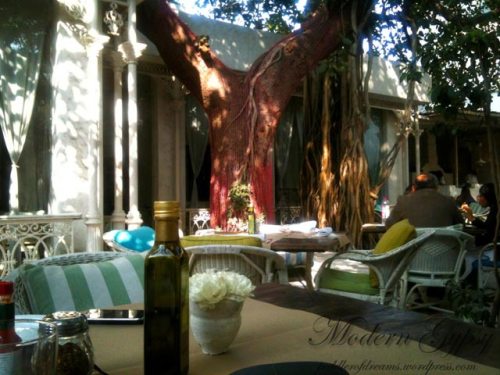
Olive is an Italian restaurant, part open part indoors. We chose to sit outside, under the shade of an ancient banyan tree on a cool winter afternoon. The seating is spread apart, so you have a bit of privacy at your table and room to let your eyes wander. From the huge banyan tree to the open kitchen to catching glimpses of the interior of the restaurant, from where a blue shelf was winking out at us.
British versions of the Harry Potter series (Photo credit: Wikipedia)
I’ve developed a love for fantasy fiction. It started with JK Rowling’s Harry Potter series, which I read through college and into adulthood. After a long break from this genre, I returned to it with Stephenie Meyer’s Twilightseries, which was recommended to me by a colleague in the US. (I don’t understand the hysteria around these novels – after reading the first book I wanted to gag, but they did seem to get better. Or maybe I knew what to expect.) Then came Philip Pullman’s His Dark Materials trilogy (Golden Compass, The Subtle Knife, The Amber Spyglass), the brilliant and complex Fire & Ice series by George RR Martin and Joanne Harris’ novels based on Norse mythology (Runemarks and Ruinlight), and I was firmly hooked onto the genre.
So when I got the opportunity to review Bartimaeus for RHI, I jumped at the chance.
The novel starts with one of King Solomon’s 17 magicians commanding the demon Bartimaeus to search “the known world for objects of beauty and power” at the behest of the king. But keeping charge of a demon is no easy task. You have to be sure that your commands are worded without any loopholes that can be exploited and that you are always within your pentacle, or the demon will be quick to kill you to gain its freedom.
“Rizim had put the other eye out on a rare occasion when our master had made a slight mistake with the words of his summoning. We’d additionally managed to scorch his backside once or twice, and there was a scar on his neck where I’d come close with a lucky ricochet, but despite a long career commanding more than a dozen formidable djinn, the magician remained vigorous and spry. He was a tough old bird.”
A feat that Bartimaeus accomplishes within the first few chapters of the novel. And that earns him the retribution of Solomon, who orders the magician Khaba to summon and enslave him. At the same time, he tasks Khaba with constructing a marvellous temple with a workforce comprising of a bunch of demons, including Bartimaeus. But true to form, Bartimaeus manages to irk King Solomon yet again, getting Khaba kicked off the temple project and sent to the desert to hunt bandits.
Meanwhile, in far away Sheba, the Queen receives a messenger from the King. Seeing as she has refused his offer of marriage multiple times, Solomon now orders her to pay him a tribute of frankenseince or see her city destroyed at the hands of an army of spirits. What makes Solomon’s threat so ominous is the ring that he discovered years ago, which allows him to summon an untold number of spirits and command the forbiddingly powerful Spirit of the Ring. The threat of this ring brings a number of magicians to Solomon’s court, whose summoned demons are used to build temples, maintain law and order and keep the peace. It’s a ring that everyone wants…but no one should have. Anyway, back to Sheba. To save her country, the queen sends Asmira, a loyal captain of her guard, to Jerusalem to kill the king and take his ring. And this is where the real fun of the novel begins.
Jonathan Stroud’s version of Jerusalem is peopled with monstrous djinnis, marids and afrits, all of whom are enslaved to a magician and must carry out their every command. He’s taken stories about King Solomon from the Old Testament and given them a magical spin, with Bartimaeus cooking up trouble, cracking humorous wisecracks and causing mayhem wherever he goes. The story has some interesting twists and turns, with evil getting its due reward (or rather, punishment) in the end.
The principal character of the novel is Bartimaeus, and he is absolutely delightful! He’s got this wicked sense of humour
“Then again, Solomon was human. And that meant he was flawed (Go on, take a look at yourself in the mirror. A good long look, if you can bear it. See? Flawed’s putting it mildly, isn’t it?)”
with a side of sarcasm
“It’s the same with spirit guises; show me a sweet little choirboy or a smiling mother and I’ll show you the hideous fanged strigoi it really is. (Not always. Just sometimes. *Your* mother is absolutely fine, for instance. Probably.)”
Jonathan has also taken care with his human characters. Asmira, for instance, goes from being convinced about her mission to kill Solomon, to feeling helpless and worthless, and finally finding her sense of purpose as the story unfolds. King Solomon too, despite being a known figure, has been given some rather interesting character twists.
Most of the chapters are narrated by Bartimaeus, and these include back stories and explanations of various magical (and other) terms – told in the form of footnotes – in his distinctive (read: witty and sarcastic) voice. Some of the chapters are narrated by Asmira and others are in third person – and all of these transitions are handled well.
What I enjoyed most about the book, though, was Bartimaeus and his wit! The Ring of Solomon is the prequel to the Bartimaeus trilogy, which I haven’t read. So, I can say with full confidence: if you haven’t read the trilogy and don’t think you want to get into one, read this one book – it works perfectly as a stand-alone novel. Me? I’m going to be reading the rest of the trilogy – I need to know what trouble Bartimaeus cooked up in modern day London! 😉
Disclaimer: I got a copy of this book from Random House India, but the review and opinions expressed are my own.
It’s Sunday afternoon. Armed with a cup of coffee, a pen and small notepad, and my iPad, I make my way to the sofa. It’s my favorite spot in the drawing room – perfectly positioned to allow me to soak up the sun in winters and directly in the path of a cross-breeze when I open the doors of the balconies in summers.
Image via CrunchBase
As I flop down on the couch, I fire up the Twitter app on my iPad and search for #TSBC. It is 3:00 pm. For the next one hour, I will be busy tweeting – replying to questions and people; retweeting and favourite-ing tweets that I like; laughing out loud at times; at others, making furious notes in a small notebook. At the end of that hour of Twitter interaction, I will come away with new thoughts and perspectives, as well as a list of interesting books or authors I knew nothing about.
Isn’t this book cover a beauty? Shared on the #TSBC chat on book covers by Random House India
See, #TSBC is the Sunday Book Club, a weekly chat that takes place on Twitter every Sunday at 3:00 pm IST where we talk all things, well, books. Topics have ranged from discussing movie adaptations of books, autobiographies, the works of Oscar Wilde, book covers, the Ramayana, banned books, and a fun discussion on what book…And, at the end of every chat, one lucky person stands to win a book*! I won First Day First Show by Anupama Chopra during one of the initial few chats on books and films. The question was “If your memoir were to be made into a film, what would you name it and who would you cast in it?” And my rather flippant answer was “The girl who tried to climb a mountain and walked down a hill. Starring Julia Roberts as me. :-P” Pretty cool, huh?
Started by three friends and book lovers Raghav, Neo and Sudha, the club is 11 weeks old. And participation (both from India and abroad) has grown by leaps and bounds. This really doesn’t come as a surprise because they have some well-thought-out questions on each topic, leading to healthy discussions among book lovers.
If you love books, this is one chat you wouldn’t want to miss! There are, however, a few Do’s and Don’ts.
No self promotion during the chat
No rudeness and flaming – please respect everyone’s point of view
Do mention which question you are answering (A1, A2 etc)
Do tag your tweets with #TSBC or they won’t reach all the Tweeps who are participating
Midnight’s Children tells the story of “Saleem Sinai, later variously called Snotnose, Stainface, Baldy, Buddha and even Piece-of-the-Moon,” who was born on 15 August 1947 at the stroke of midnight – at the same hour that India won her independence. It is a story that first chronicles 32 years of his grandparents’ and parents’ lives, before focusing on Saleem’s life in Bombay, Pakistan and Bengal. It is also a novel about India; tracing her journey from the heights of independence (infancy) to her ordinary adulthood, culminating with Indira Gandhi’s Emergency rule.
But this bland description doesn’t do justice to Rushdie’s sweeping novel. It says nothing about his magical prose, about the explosion of colors and smells and sights and sounds. So let me tell you a little more about Snotnose.
Born at midnight, at the precise moment of India’s independence, Saleem was “mysteriously handcuffed to history…thanks to the occult tyrannies of those blandly saluting clocks.” His birth was celebrated with fireworks. His picture was printed in the newspaper. Prime Minister Jawaharlal Nehru sent him a letter saying “We shall be watching over your life with the closest attention; it will be, in a sense, the mirror of our own.” He grew up with a sense of his own importance. He grew up wondering about his purpose. And in his quest for a quiet place in which to think, he found himself retreating to his mother’s laundry hamper. Where one day he discovered his gift for telepathy. From the age of nine, he could enter into other lives at will. And finally, he found all the other magically gifted midnight children scattered across India. At the age of 10 he set up a Midnight’s Children Conference, where he hoped the children could come together to discuss the fate of the nation. But like all 10-year olds, they were overtaken by petty squabbles and dissonance.
As you read Saleem’s story, the “chutnification of history” and “the pickling of time”, you can see parallels with India. Allegorical though they may be, some of them are only hinted at, but they are there. The signs of the potential that India could achieve at birth, the quest for purpose, the slow, inevitable decline to mediocrity. Of course, a lot of events take place because of Saleem. After all, the reason for the Indo-Pakistan war was the annihilation of the Sinnai family!
What more can I say about Stainface? He’s pompous, arrogant, self-centered, grandiose, and somehow loveable. As the narrator of this audacious novel he is absolutely brilliant. He jumps around from one time period to another. When he makes his tall claims, his companion Padma tries to ground him to reality, but of course, he refuses to be so grounded.
In this sweeping canvas of a story, Rushdie brings in the details of a miniaturist. The places and times are captured down to the last detail. Like the Pioneer Café, where Saleem’s mother meets her first husband Nadir Khan.
“…with filmi playback music blaring out from the cheap radio by the cash till, a long narrow greeny room lit by flickering neon, a forbidding world in which broken-toothed men sat at reccine-covered tables with crumpled cards and expressionless eyes.”
The characters, even the minor bit players, are finely detailed. No player, or event, has been tacked on as an afterthought just because an “India novel” would be incomplete without it. There is a lot of history, even though the timelines may not always be right, because Saleem admits that “Memory has its own special kind. It selects, eliminates, alters, exaggerates, minimizes, glorifies, and vilifies also; but in the end it creates its own reality, its heterogeneous but usually coherent version of events…”
In the hands of an inept writer, it would have been an impossible book to read. But Rushdie’s fine art of storytelling turns it into a rich and magical tapestry. Saleem (and through him, since this is magic realism, India) “have begun to crack all over like an old jug–that my poor body, singular, unlovely, buffeted by too much history, subjected to drainage above and drainage below, mutilated by doors, brained by spittoons, has started coming apart at the seams. In short, I am literally disintegrating, slowly for the moment, although there are signs of an acceleration.”
But it does end on a note of hope. Although Saleem, who holds the dream of India within himself, believes he will “eventually crumble into (approximately) six hundred and thirty million particles of anonymous, and necessarily, oblivious dust” as national unity seems like an unachievable dream, he does leave the reader with a sliver of hope. His son Adam, gifted with “elephant ears”, is also inexorably tied to India. In him lies the future of the nation. And who knows what feats he might achieve.
Having read the book, I am now all the more eager to watch the movie, which is slated to release in December 2012. Since Rushdie has been closely involved in the movie making process, I have high hopes from it! Overall, I think this is an excellent book, and I highly, highly recommend it.
Disclaimer: I got a copy of this book from Random House India, but the review and opinions expressed are my own.

 From the back cover:
 We left our annual vacation planning too late last year. As November rolled around with no destination in mind, I knew that it would be next to impossible to put together a proper itinerary and get reservations at decent hotels. So we decided to reduce our vacation dates – since no time to plan means you can’t visit multiple cities – and go back to Rajasthan. This time, we chose to visit Bharatpur. Famous for its bird sanctuary, it’s one of the few cities in Rajasthan that we haven’t been to yet.


 A feat that Bartimaeus accomplishes within the first few chapters of the novel. And that earns him the retribution of Solomon, who orders the magician Khaba to summon and enslave him. At the same time, he tasks Khaba with constructing a marvellous temple with a workforce comprising of a bunch of demons, including Bartimaeus. But true to form, Bartimaeus manages to irk King Solomon yet again, getting Khaba kicked off the temple project and sent to the desert to hunt bandits.

