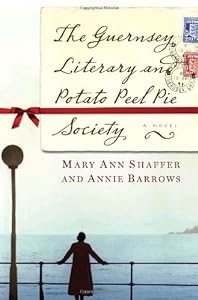
The Guernsey Literary and Potato Peel Pie Society - Cover via Amazon
I had been drawn to The Guernsey Literary and Potato Peel Pie Society by Mary Ann Shaffer and Annie Barrows a number of times on my frequent visits to the bookstore, but never did buy it. I recently borrowed it on the recommendation of a colleague, and I have to say that I was quite impressed!
The novel is based in London in 1946, after the end of World War II. The protagonist – Juliet Ashton – is a writer who has spent the war writing humorous columns for The Spectator. She receives a letter from Dawsey Adams, who lives in the island of Guernsey and who has, by chance, got her old copy of Charles Lamb’s essays. One letter leads to another and Juliet learns of the Guernsey Literary and Potato Peel Pie Society, which was established by chance during the war. Now, most book clubs are set up by people who love reading and discussing books – but not this one. It was set as a spur-of-the-moment invention by the resourceful Elizabeth McKenna, who offered it as an explanation to the Germans when she and a group of her friends were found to have broken the curfew.
Through her correspondence with Dawsey, Juliet learns about the troubles the islanders faced during the war. Encouraged by Dawsey, the rest of the book club members begin writing to Juliet to share their thoughts on books, the war, the deprivation and the daily struggle to survive. The second half of the book, when Juliet eventually makes her way to the island/s to gather material for a new, more serious, book brings out more of the plot and the eccentricities of the characters.
The most amazing part about the novel is that it is told entirely through the (fictional) correspondence between Juliet and various other people – the islanders; Sophie, her best friend and Sophie’s brother and Juliet’s publisher Sideny; and Mark V Reynolds, an American tycoon who falls in love with Juliet. Through those letters, Mary Ann Shaffer explores some of the darker aspects of the war, such as the cruelty and even humanity of some German soldiers, the moral dilemma that arose between people forced to try and survive alongside the enemy, and the horrors of the concentration camps. Those letters help to create characters that you come to love and understand – their shortcomings and motivations, their lives and loves, their passions and convictions.
Overall, this is a delightful novel – funny, moving and told in a very different manner.
Have you read this book? I’d love to hear what you thought of it!
Tons of ideas. Zero motivation. Image by orkboi via Flickr
This is the first post of this year. Almost a month into 2012. Over a month after my previous post.
After spending most of 2010 posting four times a week, week after week, I kinda dried out in 2011. I didn’t run out of ideas. I ran out of steam. Out of motivation.
That was my story for 2011. Not just for my blog – for my life. I slowed down. Despite myself. Notwithstanding all my good intentions. I just didn’t have the will to do anything. But I want to change that.
The world is going to end in 2012, or so the Mayans said. I don’t believe that means the doom and gloom that Hollywood would have us believe. It means the end of a cycle. And the end of a cycle heralds the beginning of a new one. So this year, I intend to start anew. To begin afresh.
Investing in me. Image via Flickr
I’m not in a hurry. I want to do things slow – and get them right. So I’m going to take my time. To analyze the year that was. To examine where I am and determine where I want to be. To plan. To take one step, and then another and another. To start the journey. Because that’s what’s important. The destination will come. Or it won’t.
What’s important is moving forward. Learning. Growing. Challenging yourself. Being fresh.
As I analyze, learn, and grow, I will share some of my insights with you, my wonderful readers. So if you find yourself stuck in a rut, or in need of some motivation, stay tuned. The best way to keep up with posts – through my RSS feed.
If you’ve been stuck in a rut and broken free – do share your advice in the comments. I’m on the lookout for all the help and inspiration I can find!
Recently, I wrote about how app papers are cannibalizing print newspapers, focusing on the US perspective on the newspaper industry and the monetization of digital content. At the back of my mind I was already wondering about the relevance of that trend in the Indian market.
I believe there are a few factors that set the Indian newspaper market apart. First is the low literacy level in the country, due to which newspaper penetration is low. But as literacy rates improve, so does the market potential. Tied to that is the fact that only a small percentage of Indians have access to technology. Case in point is internet penetration, which stands at just 6.9%, implying that a huge part of the Indian population is still reading the printed paper because they do not have access to an internet connection.
Second, unlike in the US, we don’t have to go to a newsstand to buy a copy of the paper every day – the paper is home delivered at no extra cost to subscribers. With that model, the number of people opting out of receiving a newspaper is limited. Moreover, newspapers are very cheap – the monthly bill for one newspaper rarely exceeds INR 200 (and that’s on the high side). It’s no wonder then that since the past few years, circulation figures of most Indian newspapers have grown by about 5% per year.
Further, the editorial integrity of print in India, and the trust that print brands are able to command vis-à-vis other media, is very high. India also has a large number of established print brands compared to the US America, where there are only really two big print brands.
Add to the mix the large number of regional languages spoken across the country, with newspapers available in all of these languages. In fact, according to the Indian Readership Survey (IRS), the Hindi-language Dainik Jagran has the highest average issue readership of 16,393,000, significantly more than the average readership of the top English-language newspaper Times of India, with 7,471,000 (figures for the second quarter of 2011).
Moreover, when it comes to the app story, just 10% of mobile phone users in India have a smartphone.
Even the recent introduction of 3G services is unlikely to make a major dent on the Indian newspaper industry due to all of the factors above. After all, with strong brands, high editorial integrity and nominal pricing, the likelihood of new media impacting core readership and threatening the value delivered is marginal.
Nevertheless, the industry cannot ignore the trends in the developed market, as it is sure to become reality in the years to come.
I for one am not likely to pay for access to news when there are so many free (and excellent) alternatives available out there.
What’s your take? Would you pay to access paid news content online?
This weekend, I had an opportunity to attend a book launch by of one of my favorite authors – Wilbur Smith, who was in India to launch his latest book Those In Peril.
The author related a number of interesting experiences from his visit to India, including the fact that he loves the traffic! Baffling, isn’t it? Until he delivered his next line: It is just like a video game; except here, if you lose, you die.”
Having visited the country numerous times, he says he thinks India as “almost a neighbor, with just a little sea between us!” When asked if he would set one of his books in the country, he referred to The Quest, one of his ancient Egyptian novels, in which his character Taita visits India to gain knowledge and wisdom. However, to weave a love affair with the country in print, the way he does with Africa, he says he’d have to “spend a lot of time here, at least 50 years, but I fear I’m running out of time”. That just explains how much research he undertakes for all of his novels.
Wilbur Smith signing copies of his books for fans Image via Wikipedia
Remember those bushmen that feature so prominently in some of his novels? He wrote them in after meeting them briefly during an excursion in the African jungle.
In answer to a question about how he manages to write so many novels (33 and counting) and if he’s ever faced writer’s block, he said that a writer’s life requires a lot of discipline as it’s easy to get distracted and do inconsequential things around the house. As for writer’s block, he said: “There’s no such thing as writer’s block. If someone says they’re suffering from writer’s block, it’s most likely cowardice.”
Very true, isn’t it? And it applies to most situations in life where we feel blocked – more often that not, we’re just scared of the unknown.
All-in-all, it was a lovely evening, spent listening to the anecdotes of an author whose fans span generations!
When I go back home on holiday, my morning routine is to fix myself a cup of tea and head down to the garden with a newspaper. I spend about an hour leisurely sipping a hot cuppa and reading the paper from cover to cover (well, almost!). Every time I return back, I promise myself that I will get up earlier so that I can read at least the headlines and a couple of stories before I rush off to work. But, I’m a late sleeper and a late riser, and reading the newspaper is something that I just cannot fit in to my morning rush to get to work. I used to try to get onto a newspaper website before I started the day at office so I was not totally oblivious to the world around me, but that didn’t always happen.
Then, I bought my iPhone and was initiated into the world of apps. The New York Times (NYT), Hindustan Times and NDTV were among the first few apps I downloaded. Of these, the NYT app is my absolute favorite. The headlines and the entire news story are downloaded when you start the app, and you can read them whenever you have a few moments to spare. I generally download the news as I run around getting ready, and then quickly scan through interesting news stories whenever I am stuck in traffic. You just gotta love technology, right?
Given our increasingly busy lifestyles and the proliferation of the internet and smartphones, it’s no wonder that newspapers (especially in the US) are seeing subscriber numbers fall. To deal with the loss of subscribers and declining ad sales, a few publishers are once again putting their online content behind a pay wall. The NYT has started asking users to pay up if they want unlimited access to digital content, and News Corp. put so much faith in the proliferation of content on tablets and on the success of Apple’s offering that it launched an iPad only subscription news magazine The Daily.
Are these moves warranted? Recent figures seem to say yes.
Paid subscriptions to read News Corp’s Wall Street Journal on tablets (Kindle, Nook, iPad and Android tablets) quadrupled to 200,000 in 2010 from about 50,000 a year ago. Though this may be a very small figure compared to the 1.6 million print copies that are circulated each day, it is a huge leap forward, and may well be the start of a brand new trend. Who knows, the day might come when people will have to go a museum to see what a printed newspaper looked like!
What’s your take? Do you prefer to read a newspaper the old fashioned way, or have you moved online?
Recently, I’ve been reading books and watching movies related to women’s rights (or lack thereof) and their suppression by the men in their family. It wasn’t a conscious choice, it’s just something that happened by chance. It started with Elizabeth Gilbert’s Committed, in which she devotes almost an entire chapter to marriages of convenience in the 1930s. Such marriages were very prevalent in India even until a decade ago – and still are in a number of communities. These are marriages between families, where oftentimes the woman isn’t really given much choice in the matter. The men, of course, can choose – and that choice was almost always based on something as transient as looks. In Margaret Atwood’s The Blind Assassin, the main protagonist, Iris, was married off to industrialist Richard Griffin to save her family’s factories. The novel follows her disastrous marriage and the sexual abuse her sister suffered at the hands of her husband. Both of these books present the plight of the woman as a thing of the past, but not Bol. This is a bold movie to have come out of Pakistan recently, and highlights the plight of women, who are subjected to the tyranny of the male head of the house, in the present day. The movie deals with a number of important issues in that country – birth control, discrimination against gays, and the lack of choice for women. Some would think these issues are currently faced mainly by developing countries. They would be wrong.
As I read The Men Behind The War on Women on Huffington Post recently, I was shocked and enraged at the blatant disregard displayed by The U.S. Conference of Catholic Bishops with regard to women’s reproductive health.
“Over the past two years the GOP-controlled House of Representatives has launched one of the most extreme assaults on women’s choice the U.S. has seen in decades. Republicans voted twice to slash federal family planning funds for low-income women, moved to prevent women from using their own money to buy insurance plans that cover abortion, introduced legislation that would force women to have ultrasounds before receiving an abortion and, most recently, passed a bill that will allow hospitals to refuse to perform emergency abortions for women with life-threatening pregnancy complications. But the erosion of women’s rights didn’t begin with the GOP takeover…Lift the curtain, and behind the assault was the conference of bishops.”
Abortion stops a beating heart (Image by wht_wolf9653 via Flickr)
As if this weren’t enough, the Catholic Bishops have now launched a high-intensity campaign against birth control. Yes. Against.
I thought it was only the poor and uneducated lot who still thought that birth control was a direct affront to the heavens and that once married, women were supposed to set up a baby production factory. Apparently, I was wrong. The church, of course, has always been anti-abortion, but to take away choice from women, even in the case of rape, incest or complications and potential danger to the mother’s life, is barbaric.
The bishops are now lobbying against The Department of Health and Human Services’ (HHS) insurance coverage guidelines stating that all health plans under the Affordable Care Act cover birth control at no cost for women. Although the rules offer religious exemption to churches, Catholic-affiliated organizations such as charities and hospitals would still have to cover birth control for their employees.
Arguing that the exemption is too narrow, the bishops want the Obama administration to either entirely remove the coverage of birth control or to offer an exemption to all Catholic organizations. This would mean that thousands of women who work for these organizations, even if they are not themselves Catholic, would be denied the preventative health coverage options available to most other women in the US.
HQ of the HHS
If you thought the bishops were lobbying for these measures only on religious grounds, you would be wrong. They’re fighting because of the large sums of money at stake. The HHS recently dropped the bishops from a five-year, $19 million contract to help victims of sexual trafficking. The bishops think they were dropped because they do not offer victims the full range of contraceptive and gynecological services, such as abortion referrals, birth control pills and condoms, provided by other agencies.
At the end of the day, then, it is the lure of money that is going to strip women of their rights and choice when it comes to their personal reproductive health and even their life.
Bishop William Lori defends the bishops’ actions thus: “We recognize that not everybody shares that teaching; nevertheless, it is a fundamental right for the church to stand by their convictions.” Doesn’t this reek of duplicity? By forcing legislation that will deny birth control and abortion to millions of women, the bishops are effectively imposing their views on the fundamental rights of individuals.
What’s probably worse, though, is that this isn’t the only legislation in question. Women across US states have lost major ground this year. Already, about 80 measures have been enacted to restrict access to abortion, all of which violate international human rights standards. These include Ohio’s ban on abortion once a heartbeat can be detected (6–10 weeks’ gestation); and a state ballot initiative in Mississippi, which if passed, would mandate personhood from the moment of fertilization. This could potentially outlaw the most popular forms of contraception; would treat destroyed eggs as murder victims, essentially making abortion illegal; and would prohibit scientists from destroying embryos created in laboratories, a process that is often required during in vitro fertilization and scientific research.
No matter what your individual stand on abortion might be, most of these measures go against a number of commonly accepted reproductive and human rights. Indeed, as the world moves towards decriminalizing abortion, one of the most developed nations is effectively muzzling women’s right to choice.
So begins The Storyteller of Marrakesh. This literary mystery is narrated by Hassan, who belongs to a family of traditional storytellers. He has set up his kilim (blanket) in the Jemma el Fna and is preparing to tell a story
…the like of which I promise you have never heard before. It is a love story, like all the best stories, but it is also a mystery, for it concerns the disappearance of one of the lovers or the other or perhaps both of them or neither.
And so Hassan begins weaving his tale, one which he feels compelled to retell once a year. The story revolves around Lucia, a half American half French woman and her Indian lover. It revolves around his brother Mustafa, who fell in love with Lucia, and then, a week after the disappearance of the tourists, turned himself in to the police in connection with their disappearance. It revolves around the day those tourists spent at the Jemma and around all of those who came in contact with them. It revolves around her beauty and the passions that it ignited in all the men who had the fortune, or misfortune, to meet her that day.
Jemma el Fna square by night Image via Wikipedia
There is a story within a story within a story, with all the listeners present invited to come forward and talk about their meeting with the foreigners that day. Through the collective memories of all who are gathered around Hassan, and all of whom were at the Jemma on that day, emerges a narrative of the various sightings of this mysterious couple. There are premonitions, superstitions, and men driven mad with desire for the girl. Through the stories, you get a glimpse of the Jemma, of the heady world of Marrakesh and an insight into traditional Islamic culture.
The many narratives weave together into an intricate mosaic, at the end of which you aren’t sure of Hassan’s role in the entire affair. Is his compulsion to repeat this story every year simply his effort to exonerate his brother, Mustafa, from the crime? Or is Hassan himself involved in the mystery?
In the true tradition of oral storytelling, there are as many questions as there are answers. As many loose ends as tied.
A storyteller at Marrakesh Image by theboybg via Flickr
One thing is for sure, Bhattacharya has a way with words. Although all of the action takes place around Hassan at the Jemma, and the entire novel is set during one evening of storytelling, you’ll be immersed in the sights and sounds of the “most storied city square in the word,” travel the Sahara, and hear the dolphins play in the ocean.
This is the first in a planned trilogy set in the Islamic world. I only hope that the rest of the novels don’t take this story forward. For though some things may be left open to interpretation, I think a trilogy would spoil the mystery of this novel and go against the form of storytelling Bhattacharya has employed here.
Overall, this is an interesting book that I found really hard to put down (and that, in part, made me determined to take the reading deprivation challenge). Highly recommended.
I am from the paint streaked canvas, from a box of fine Godiva chocolates and a flute of sweet rose wine.
I am from the sheltered world of Ashoka lined row houses, the smell of the jasmine flower wafting through the warm summer breeze.
I am from the river flowing fast and hard in the back yard, the huge Gulmohar tree whose branches lent themselves to day dreams.
I am from family dinners and knowledge seekers, from Mehrotras and Seths and Tandons.
I am from the young at heart, the rose tinted glasses never quite coming off. From instructions to be home before sundown and advice to always follow your heart.
I am from Shiva and Laxmi and the whole Hindu pantheon. From morning prayers and the sweet smell of incense floating in the air.
I am from a hospital by the sea in Singapore, descended from Aryans belonging to the verdant north Indian plains, from summer yellow lentils and golden wheat bread.
From the love and indulgence of my grandfather, the unquestioned love of my grandmother, the discipline imposed by my mother and the reasoning offered by my father.
I am from memories made all over the world as I sailed the seas with my parents, from piles of photographs stored in the cupboard and beautiful paintings lining the walls.
I am from dreams spun curled up at the window near my study table, from stories read and re-read on lazy summers spent belly down in the cool, green grass.
I am from friends real and imaginary, from a baby sister I fought with and for, from rebellions and reconciliations, from love, love, love.
Oh, the smell of fresh paper. The feel of the rough page beneath my hand. The sense of possibilities expanding before me, as I gathered together my thoughts, put pen to paper, and wrote.
Gone are those good old days of keeping a hand-written journal. Of carrying around a diary everywhere I went, so I was never stumped if inspiration struck, or if I saw a particularly good quote that I wanted to note down forever, or just wanted to ruminate.
Click image to purchase on Amazon
Gone are those days spent flicking through old journals. Looking at ticket stubs from that movie I went for on my first date. Of the restaurant bill from the last time I met up with my gang. The coffee spill that put so much more atmosphere into the story of me that I was writing.
All of that has been replaced with my iPhone. True, it’s much smaller and lighter than my diary. It’s with me everywhere I go. The chances of my forgetting it anywhere are slim. But it’s just not the same as my dear diary.
There are no pages to rifle through. No coffee spills to highlight passages of my life. No drunken scrawls that I cannot decipher the morning after. It’s too neat. Too structured. Too…cold.
Click image to purchase on Amazon
Maybe its time for me to go and buy myself a new diary. A leather-bound one this time, maybe. To doodle. To write. To keep for posterity. So that years later, when I am dust scattered over the earth, someone can come across it and say “Oh, so that’s what writing looked like in those ancient days!”
What do you think? Do you miss your hand-written diary? Or are you happy recording your thoughts digitally?
Sweet Sanctuary tells the story of single mom Wren and her gifted son Charlie. It tells the story of Wren’s family, of how it was torn apart by a horrible incident in their childhood. It weaves in romance, forgiveness and faith.
Yes, there is a strong Christian tone to the story. There’s a lot about putting your faith in God and trusting in him to show you the way. But if you can live with that, you will be rewarded with a beautiful story and wonderful characters.
Sheila Walsh has crafted a fine tale populated with a cast of characters you’ll come to care about. Wren, a librarian with a love for books and a penchant for wondering how her favorite female literary characters will react to any given situation, is struggling to fully accept the Lord and hand over her worries to him. Charlie is a wonderful 10-year old gifted boy who prays to see is mother happy again. That happiness comes from Paul, the restaurant owner who Wren eventually, despite herself, falls in love with, and from the forgiveness and healing of Bette stop ship with her elder sister Barb and younger brother Jack.
Despite the fact that I am not a Christian or into Faith-based books, I enjoyed this novel. I think it would make for a good summer read.



 This weekend, I had an opportunity to attend a book launch by of one of my favorite authors – Wilbur Smith, who was in India to launch his latest book Those In Peril.


 Gone are those days spent flicking through old journals. Looking at ticket stubs from that movie I went for on my first date. Of the restaurant bill from the last time I met up with my gang. The coffee spill that put so much more atmosphere into the story of me that I was writing.
 Maybe its time for me to go and buy myself a new diary. A leather-bound one this time, maybe. To doodle. To write. To keep for posterity. So that years later, when I am dust scattered over the earth, someone can come across it and say “Oh, so that’s what writing looked like in those ancient days!”