I have to admit, I’m kinda sad to see the end of March. I absolutely loved the energy of the month, as I spent some time every single day at the painty table. Ah, how that makes my heart sing! I’ve also made excellent progress with my oracle card deck; now, I need to take a bit of a pause and see what elements are missing from making it a cohesive deck. As I put the deck to the test, I thought it would be fun to use them for your Tarot {rather Oracle} reading for April! This month we have a 2-card spread, that tells us what to embrace and what to release.
Remember, this is a general Tarot reading for April, and my intention with this one was: What do my blog readers need to know this month.Continue reading→
I don’t know about you, but I’m glad to see the end of February! The month has been marked with allergy attacks and a general sense of discontent, but March blew in with a breath of fresh air. Maybe some of it has to do with the fact that the month started with a four-day weekend, most of which I have spent at the painty table! Anyhoo! Without further ado, here’s your tarot reading for March 2018.
Remember, this is a general Tarot reading for March and my intention with this one was: What do my blog readers need to know this month.Continue reading→
I can hardly believe it’s November already! The last month has been really busy, but I’m looking forward to the shorter days and the cool winds. And of course, some planning from the coming year. Anyway, here is your Tarot forecast for November 2017.
Remember, this is a general Tarot reading for November and my intention with this one was: What do my blog readers need to know this month.Continue reading→
It’s officially almost the last quarter of the year! I have to admit this is my favorite time of the year. The festive season is kicking off, winters are setting in, making it a beautiful in-between time of outward gaiety and inward reflection. Anyway, here is your Tarot forecast for October 2017.
Remember, this is a general Tarot reading for October and my intention with this one was: What do my blog readers need to know this month.Continue reading→
It’s surprising, how you sometimes have nothing much to say.
It’s even more surprising – and unnerving – when this happens after a period of intense creativity.
But there’s a reason for the quiet…for the lack of words…the lethargy in the drive…the dip in the zest.
After every creative high comes a creative low. It’s simply a time to recuperate, to gather up seeds of inspiration once again, to go down the rabbit hole as you follow your curiosity so you can come back again, filled with wonder and words and delight and magic.
I start each morning with a moment of mindfulness, spending some time with a simple question and a single card drawn from my Tarot deck.
Each morning the cards reflect back a nugget of wisdom – it could be a simple reminder telling me to stay focused on the task at hand; a not-so-subtle push to stop day dreaming and start doing already; or an indication of a broader energy that I may need to work with during the day.
For today’s daily Tarot pull, I sat with this simple question:
What do I need to know about personal transformation?
When I drew the card and wrote down the message in my Tarot journal, I immediately knew that this was something that needed to be shared. Continue reading→
This is a common question that many people ask when they’re starting out on an inner quest – Tarot Cards or Oracle Cards – which are better? How are they different? Let me try to break it down for you.
The difference between Tarot and Oracle cards
Both the Tarot and Oracle cards can be powerful tools for personal growth, inspiration and divination. So there is no major difference there. Where they really differ is in their structure.
No matter which Tarot deck you buy or which system it follows, a Tarot deck always has 78 cards. These cards are always divided into 22 Major Arcana cards and 56 Minor Arcana cards. The 22 Major Arcana cards always depict major events and turning points in our lives. The naming conventions may differ slightly from deck to deck, but the broad meanings are largely similar.
The rest of the 56 Minor Arcana cards are suit cards – wands, swords, cups and pentacles. These represent the daily ebb and flow of life. Each of these is related to one of the four elements and a particular trait.Continue reading→
In my previous post, I shared a bit about the history of the Tarot and briefly introduced you to the cards. Today, let me tell you how the Tarot works – and doesn’t work.
There’s a lot of mystery surrounding the Tarot, which isn’t surprising given its portrayal in the movies. Picture this:
A young girl goes to a fortune teller, who pulls out the Death cards and says something like: “Oh, Death! Someone you love is going to die today!” *Cue dramatic music in the background.*
I say: Bullshit!
From the Mary-El Tarot Tarot deck – I love this version of the card. It depicts what Death truly represents – the end of a cycle or transformation.
For one, Death very rarely means the literal death of someone – so breathe! For another, the Tarot does not tell you exactly what will happen, or exactly when it will happen, and a reading isn’t set in stone. Hello, free will!
The Tarot of Jacques Viéville (Paris 1650) Public Domain
When I wrote about the Tarot last month, I didn’t expect so many of you to be interested in both a reading and in knowing more about the cards! Since so many of you asked, here’s some information on the Tarot.
A brief history of Tarot
The origin of the Tarot is a bit of a mystery. Some sources say the cards originated in Italy in the 15th century, others that they’ve been around since the mid-18th century. But what is largely undisputed is that the cards were discovered by scholars of the occult in the later part of the 18th and 19th centuries. They connected the cards to Egyptian philosophy, the Kabbalah, alchemy and other systems.
However, Arthur Edward Waite is largely viewed as the father of modern Tarot. In the 20th century, he commissioned artist Pamela Coleman Smith to create what he called the “rectified” Tarot. His version of the cards has been widely accepted as the standard, and is by far the most popular deck – and the easiest for those looking to learn the Tarot given its rich symbolism and the simple artwork.Continue reading→
The loud ringing of the alarm on my cellphone jerks me out of bed and running helter-skelter to face the day every morning. I rush through the house like a whirlwind – brush, bath, get dressed, put out some cat food, grab a cereal bar and race to work. It doesn’t have to be that way.
Instead of waiting for the last alarm (I have three, in case you’re wondering) to jolt me into action, I can get up with the first, or even the second, and ease myself into the day. On the days when I’ve managed to do that, I make myself a cup of hot lemon tea and do nothing until I’ve finished it. It’s my time to think, dream, imagine…before I go forth to meet the world. I’ve noticed that on those days I’m calmer, more focussed and less stressed out.
But I haven’t really done anything about that observation…until recently. And for that, I have to thank Pilar Gerasimo for her article, Reclaim your mornings. According to Pilar, you need to create a morning ritual
Image by Ray Devlin via Flickr
for yourself and ensure that you do it everyday. Your ritual can be long and elaborate or short and simple, but the key to success is to have a minimum commitment – i.e., on the days when you don’t have enough time, spend at least 5 minutes with yourself before you take on the world. Pilar also shares her sister Andrea’s morning ritual. She…
“lights a candle and a stick of incense, then puts on relaxing music. She unrolls her yoga mat, sits, and — at minimum — takes three long, centering breaths. Generally, those three deep breaths lead her into a gentle yoga practice that may last anywhere from 5 to 30 minutes. At the end of her practice, she meditates for a few moments, sending loving thoughts to her friends and family, and setting some key intentions for the day. When her mat-based practice is complete, she makes tea, has breakfast, and only then does she turn on her phone, consult her calendar and begin the active portion of her day.”
Her minimum commitment from this long ritual is to “Unroll the mat, sit, take three breaths. That’s it. The rest is negotiable.”
This inspired me to design a morning ritual for myself.
Image By derekGavey via Flickr
I find a comfortable spot to sit in – could be cross-legged on the bed, or on the drawing in the drawing room. I take three deep breaths, and do a short guided meditation to start the day on a positive note. Then, I draw a Card for the day to give me a feel of the vibrations and the things to watch out for. After that, breakfast, and then I’m ready to face the day. My minimum daily commitment is to take three deep breaths and draw a card for the day.
I’ve been doing this since the past three weeks, and already, I feel a tangible difference in the texture of my days. What small ritual can you create for yourself every morning, or do you already have a morning ritual? Tell me about it in the comments!


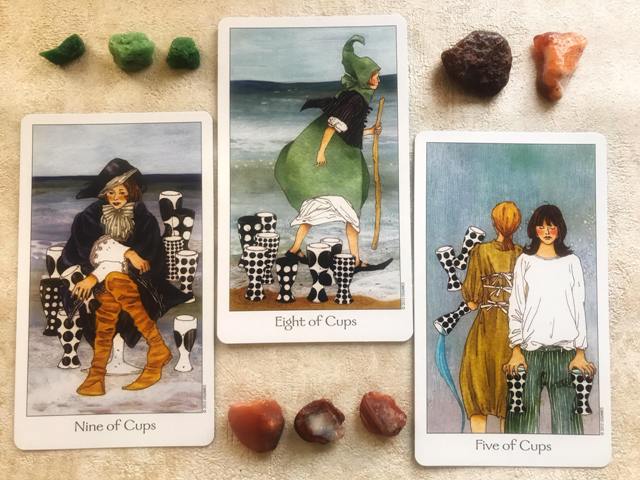

 I start each morning with a moment of mindfulness, spending some time with a simple question and a single card drawn from my Tarot deck.
 No matter which Tarot deck you buy or which system it follows, a Tarot deck always has 78 cards. These cards are always divided into 22 Major Arcana cards and 56 Minor Arcana cards. The 22 Major Arcana cards always depict major events and turning points in our lives. The naming conventions may differ slightly from deck to deck, but the broad meanings are largely similar.


